

Readings: Matthew 20:1–16, Philippians 1:21-30
We envy people who seem to have received more. Here at Teynham, we are often jealous—in a good way—of the first disciples. Imagine having the opportunity to walk, talk, and live alongside Jesus! By God’s providence, and after a night of deep prayer, those simple fishermen were found by the richest man in the world. Yet, he looked nothing like the rich men they expected. As Saint Paul would later write: “Though he was rich, yet for your sake he became poor, so that you through his poverty might become rich” (2 Cor. 8:9).
In response, Peter and the others left their families and their successful fishing businesses just to be with him. For three and a half remarkable years, they stayed by his side to learn how to be as loving, caring, and generous as Jesus. Aren’t they lucky? Well, yes—but not in the way they thought.
The Skewed Picture of God
Their picture of God was initially so skewed. If a rich young ruler showed up, the disciples would have signed him up on the spot! Yet Jesus let that wealthy young man walk away grieving and empty-handed. In their minds, the disciples carried centuries of Jewish cultural heritage: Abraham, Isaac, and Jacob with their vast flocks, Solomon with his golden Temple, Job with his restored estates. To them, divine favor looked like earthly prominence and material wealth.And yet, Jesus turns to them and begins talking about the apparent losers: the latecomers, the midday-heat-avoiders, the nobodies.Look at what has just happened in Matthew’s Gospel. The disciples have just been reprimanded by Jesus for trying to push children away. Then the rich young ruler walks away because he cannot part with his wealth. And right on the heels of that, Peter asks the question that was really on everyone’s mind:
“We have left everything to follow you. What then will there be for us?”
Peter is asking a very logical, very human question: Is our suffering here worth our future reward there? In Peter’s estimation—and often in ours—the rich, the pious, and the hardworking Pharisees should be first in line for the Kingdom of Heaven. As for everyone else? God only knows. Jesus flips the tables on Peter’s logic. He introduces a heavenly paradox of reversal: “The last will be first, and the first last.”
The Internal “Sufferometer”
In Peter’s transactional question, I hear the quiet echo of another character in Scripture—the Elder Brother in the parable of the Prodigal Son: “Look! All these years I have been slaving for you and never disobeyed your orders. Yet you never gave me even a young goat…” (Luke 15:29).Perhaps the disciples had an internal sufferometer. They had left everything. They had endured hardship. Therefore, surely, they should receive more!
And don’t we carry a sufferometer too? We log our hours, our sacrifices, our disappointments, and even our faithfulness. We quietly keep score.To address Peter’s anxiety, Jesus gives a direct promise: everyone who has left houses, family, or fields for His sake will receive a hundredfold return and inherit eternal life. But Mark’s Gospel adds a vital detail to Jesus’ words: those blessings arrive “with persecutions.” Suffering isn’t something we bargain away; it remains part of the journey.
So how does God’s fatherly, merciful economy actually work? Jesus tells a story.
The Kent Orchard & The Denarius
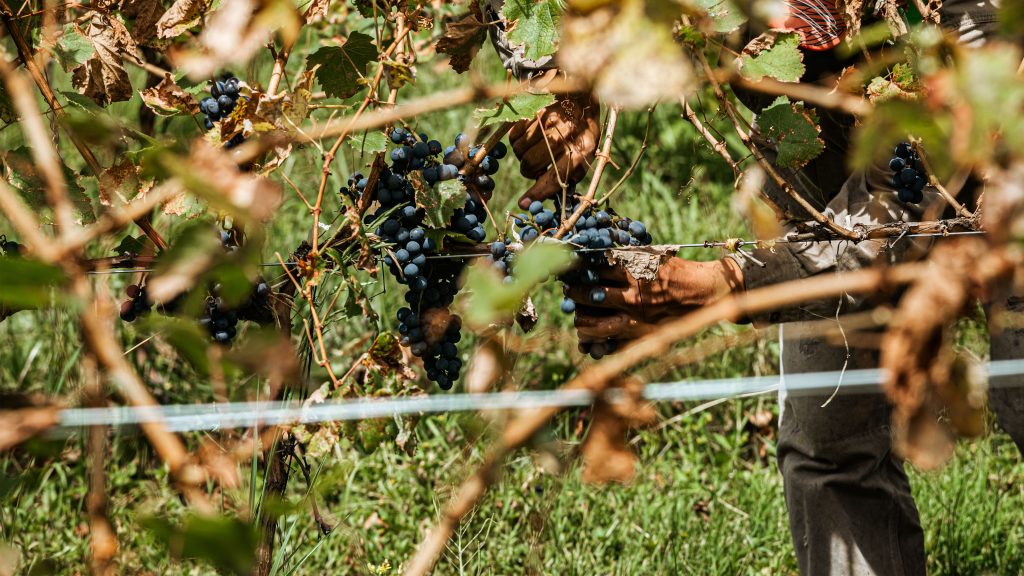
A landowner goes out repeatedly throughout the day to hire laborers. He needs the work done. Rings any bells? Perhaps you remember when fruit farmers here in our own Kent orchards had bumper harvests and needed every available pair of hands in the field.I want you to look at this picture and imagine workers in the field just like these ones—working from early in the morning, when all you want to do is sleep a little longer, to midday, when the sun is at its zenith, to the late afternoon, when you sweat under the weight of those grapes, to the evening when all you want is to learn the art of disappearing completely. That is some hard toil. Feel it? Let’s go back to the text then.
When the sun is almost behind the horizon, at the eleventh hour, just before nightfall, the landowner finds men still standing around in the marketplace. Why? Because no one hired them. They were the overlooked, the unchosen, the long-term unemployed. He sends them into the vineyard anyway.When the working day ends, the landowner sets up a deliberate test. Jesus makes us watch as the latecomers get paid first. And then comes the inevitable explosion from the workers who put in twelve hours:
“Why would he give them the same? They only worked one hour!”
Now, remember: a denarius wasn’t abstract bonus money. It was a standard day’s wage—the exact amount a first-century family needed to buy bread and survive for twenty-four hours. The landowner’s generosity isn’t rewarding sheer productivity; it is preserving human life and family dignity. He comes to the rescue of the latecomers so their children will not go hungry tonight.When we feel burned out or underappreciated, it is easy to begrudge God’s generosity to others. We end up acting like that resentful Elder Brother. The landowner asks the ultimate question: “Am I not allowed to do what I choose with what belongs to me? Or do you begrudge my generosity?”Jesus is adamant: God’s salvation cannot be earned on a punch card. It must be received with childlike wonder. God distributes His gifts through the Holy Spirit as He sees fit—to His beloved children, not to hirelings haggling over contract wages.Jesus drops the microphone on our internal sufferometers. Those who suffered twelve hours under the scorching sun get a denarius. Those who worked one hour get a denarius.
Throwing Away the Punch Card
If we could choose, we might prefer the easy eleventh-hour shift. But imagine if the Apostle Paul had taken that attitude!
Paul worked long, exhausting hours in God’s vineyard across Asia Minor. He endured beatings, shipwrecks, and imprisonment. In fact, when he wrote his letter to the Philippians from a prison cell—a letter that is completely upbeat, telling us to ‘rejoice in the Lord always’—Paul wasn’t complaining. He wasn’t checking his sufferometer, trying to ‘cash out’ his sufferings. No. Instead, his life was anchored in love, as we read in Philippians: “For to me, to live is Christ and to die is gain” (Phil. 1:21).
Paul went from being first among the persecutors of Christ to calling himself “the least of the apostles” and “the chief of sinners.” He understood this reversal completely. When Paul pleaded with God to remove his suffering, Jesus recalibrated his internal sufferometer once and for all: “My grace is sufficient for you” (2 Cor. 12:9).
Because Paul worked long hours out of love rather than legalism, the Gospel spread—and centuries later, reached us. It is no accident that our local churches here bear names like St. Peter and St. Paul: monuments to men who stopped keeping score and surrendered to grace.
When we look at Jesus—who became the last, the servant who poured out His life on the cross to open heaven to us—we are left stunned. He offers us the only punch card that matters: His own, covered in His precious blood.
Unlike the gates at Doddington Place Gardens down the road—our local garden that requires a paid annual pass—the gates of God’s vineyard swing wide open to all.
Let us pray.
Precious Jesus, I am here today only because of your gracious invitation. Your Father is not an arbitrary punch-card manager—He is love.I am bewildered by your kindness, Jesus, and astonished that your love found me on the highways and byways of the world. Thank you for giving me hope and inviting me to labor in your vineyard.I dare not bring my own punch card—it doesn’t have enough hours, and it only reveals my inadequacy. Instead, I cling to your punch card, covered in your precious blood. You are enough.Father, I marvel at your generosity. You gave your Son so that we might enjoy your goodness forever. Amen.
(pause)
Rest quietly in a goodness you cannot earn. Stop ranking your worth against the other workers. For when you do, you will finally see that glorious day of grace—when the first will be last, and the last first….And be warned: next week, we will see that those we expected to be trailing at the very back of the line have somehow slipped through the gates ahead of us all.