

For brevity I will only discuss the main themes of the “Much Ado About Nothing” and “Romeo and Juliet”. In first we find a great accent is put on words as such.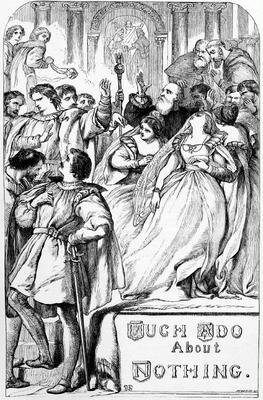 There are two main pairs of characters: Beatrice and Benedict together with Claudio and Hero. First “future” couple seems to be more aged and mature, and they constantly show their wit by saying witty words. Those words are “…a skirmish of wit” and at one point Benedict makes conclusion that both he and Beatrice are “…too wise to woo peaceably”. Especially we see the power of words in the scene were Beatrice teases Benedict and at the ball time calls him “a king’s jester”. At that Benedict is very much grieved and says that “she speaks poniards and every word stabs.” I would say that in general, this play is an illustration on wrong use of the tongue. Words are wonderful when they are used with love and for a good purpose, but malice (as in Don John’s case) can make daggers, knives out of the words which can ruin lives. Deception and cuckoldry are the main themes of this comedy.
The whole story revolves around two mischievous intrigues. One is in a way good and another is totally evil. Both use words given to people either through the third parties or heard by eavesdropping. People who see Beatrice and Benedict’s relationships decide to act as suitors and by using the “arranged eavesdropping” technique make both Beatrice and Benedict think about each other more affectionately. Finally that is consummated in marriage. Another line of heroes though have to go to that through struggle. That happens according to the author’s plan. Don John the bastard hates his brother Don Pedro and is ready to grieve him in any possible way. So he decides to blackmail Hero before she marries Claudio. He succeeds in that partly because of the men’s fear to be cuckold and partly because of the false witnesses: Boraccio and Konrad. Finally all of lies are unmasked and the truth is being celebrated in capturing evil men and two marriages. As we already discussed this comedy is different from tragedy because most of its applications are universal, in a broad sense and though the relationships go through some chilling death experience, afterwards they are being revived and reach full resurrection. In the same manner how everything was created by the word of God, so everything was resurrected and brought back to life by the mighty power of the Word of God. I think this story is a good illustration to that. Hero who was thought to be dead says that she was dead only when her slander lived. That is how important to speak truth all the time. Lies kill. And they kill so surely, that people become imprisoned inside in the souls, like “dead men walking” not finding peace to their souls because of slander and ill reports. So comedy have a very happy ending. Evil is not publicly punished, but suppressed and restricted. And usually there is a wedding in the end, which speaks to people about the the circle of life and to some about the Vegetation Myth.
Not so is the case with tragedy. Here the doom of the protagonist is prophesied in the fifth line of the introduction. “Romeo and Juliet” is an intense tragedy. It keeps the audience in an awakened emotional state from start to finish. Like it becomes of tragedies it is very personal, specific, when flaws are found, there is not just “brain and wit jousting” but straight fighting. Death is not figurative but literal. It is more likely that the final scene is going to be a graveyard and not a feasting table. And so it happens in the tragic love story of Romeo and Juliet. I think that the main motif of this tragedy is love doomed to failure. Like in Sophocles Aedipus gods said that his destiny would be to commit fratricide and incest and so it happened, so also here to “star-crossed” lovers. I think that author’s understanding about love is very philosophical. He states through the lips of Romeo the oxymoron contradictions of love: “…Feather of lead, bright smoke, cold fire, sick health, still-waking sleep.” That kind of love does Romeo feel. Everything is very much real in tragedy: death of Romeo’s best friend Mercutio, death of Juliet’s cousin Tybalt, death of Romeo and death of Juliet are painted with very grim yet detailed strokes. Lots of underground themes of money (gold), pride, sexual innuendoes, fatal coincidences add to the complexity and sharpness of the main characters.
So main differences in “Much Ado About Nothing” and “Romeo and Juliet” are obvious. In comedy words do lots of harm, but it is possible to solve the situation without the use of power.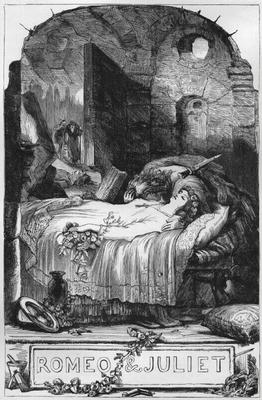 No brute force is used to vindicate yourself or to revenge. Most things are done as it was stated by slander, gossip and eavesdropping. In tragedy the author deliberately is emphasizing the details which can start a quarrel: “licking of a thumb”, being cross because someone touched your dog, considering every small thing as an opportunity for the street fighting. More than that, the author goes on and tells us, what the effect of every particular sin is. If in Hamlet, the brother poisoning the brother, series of killings, insanity of Othelia show a deep sign of wrong choices, and author even tries to provide a way to escape for Hamlet’s mother:
QUEEN GERTRUDE: O Hamlet, thou hast cleft my heart in twain!
HAMLET: O, throw away the worser part of it,
And live the purer with the other half. (Act 3, scene 4, line 147-149)
In Romeo and Juliet I saw more of a fatalistic view of events. Both of the young people are careless of tomorrow. Julia’s father is from the clan of Capuletis and Romeo is from the house of Montagues. Those two are doomed to fight till something extraordinary happens. And until two young men sacrifice their lives in the church, the war seems to provide abundant food for the Underworld. Death is pretty much the end of it all in tragedy. There is no bridge of hope for resurrection. However dispite the differences, I found that there are some similarities between the above described literary works. There is that category of time or timeliness of events, which brings about some special scenes. Those are like “little coincidences” which bring about the destiny of the people of the play. In “Much Ado About Nothing” it is intentional eavesdropping in the garden to both Benedict and Beatrice, timely confession of Boraccio, one of the guards ability to discover the mischief of Don Juan. In “Romeo and Juliet” those are even more delicate – the slight difference in time between awakening of Juliet and Romeo’s death – “his lips are still warm”, Romeo’s hand at Mercutio’s death, the time of Paris’ coming to the church yard all of those details are skillfully chosen by the writer. In both works “coincidences” are chosen in such a manner that we believe that it could have happened in real life, even if we question some “lethargic sleep” medicines of Friar Laurence.
Finally, I wanted to compare the effects which selected comedy and a tragedy leave on their respective audiences. If in “Much Ado About Nothing” we could laugh and learn some lessons on how to hold our tongue behind our teeth, then in “Romeo and Juliet” our hearts empathize with young people, because we agree that it is not just them who are in trouble, we would be able to screw everything up perhaps even faster then Shakespeare would want us to. The underlying motif of hopelessness in “Romeo and Juliet” makes us think after we leave the theatre longer than after comedy. After witnessing so many deaths we sharply realize our own falsehood and depravity of our nature, our magnetism towards forbidden dainties of this world. We as audience continually ask two very important questions in our deepest hearts: “Who is guilty?” and “What to do about it?”
And I personally think that until a person honestly asked and found an answer for those, he has all the right to be curious and receive a blessing for finding those answers. Both a comedy and a tragedy move people to think, yet I think that the effect of the catharsis after tragedies is more powerful and long lasting. If all sexual innuendos and sexual lightness in both plays were deleted or put in a right perspective, I think it would be eternal. Anyway theatre is not a church, and Shakespeare is not a preacher, so I think that as for the depth and breadth of its scope and implications there are very few who could be equal to his talent in his lifetime.