

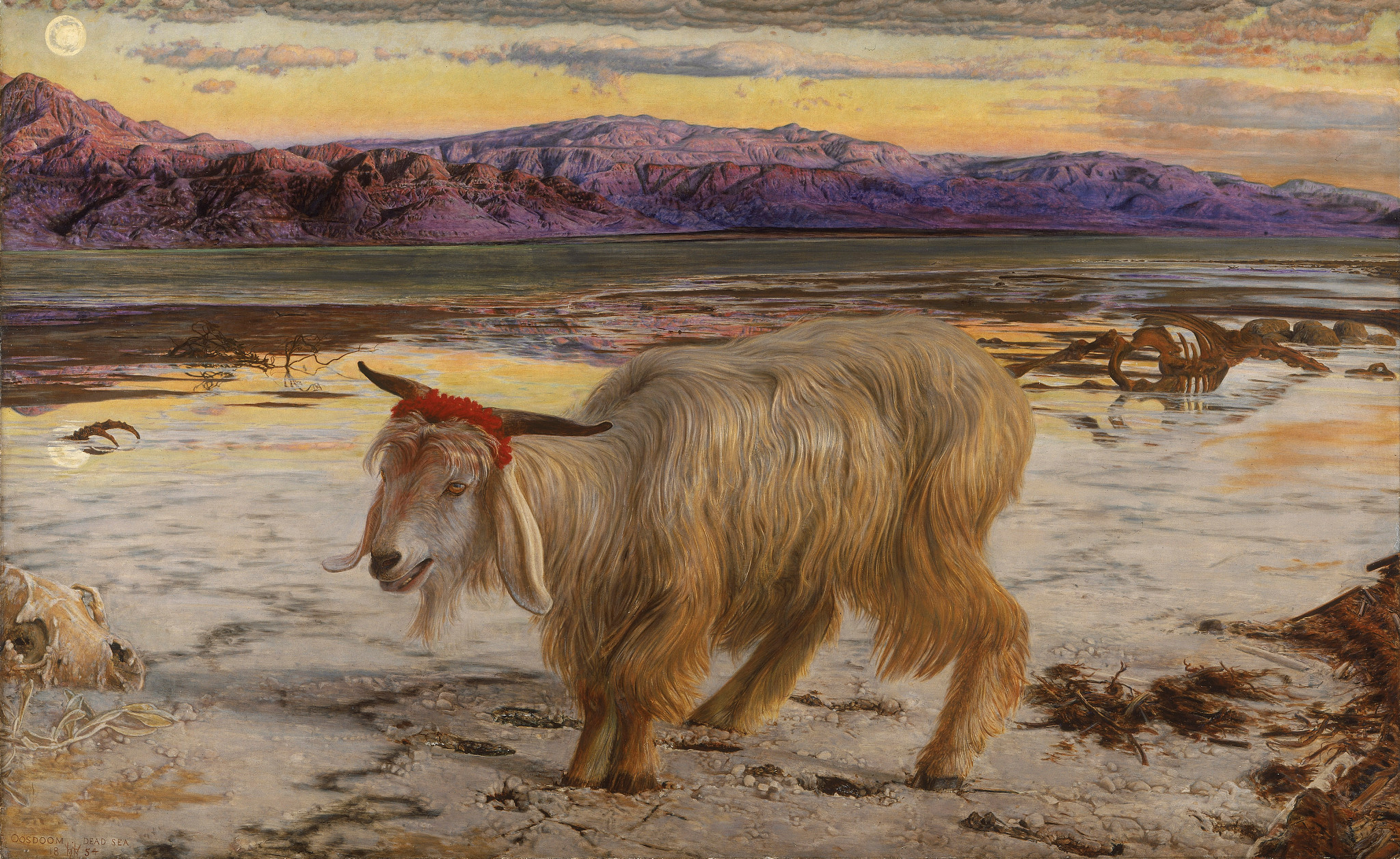
Gambart, the picture-dealer, was ever shrewd and entertaining. He came in his turn to my studio, and I led him to The Scapegoat. “What do you call that?”
“The Scapegoat.”
“Yes; but what is it doing?”
“You will understand by the title, Le bouc expiatoire.”
“But why expiatoire?” he asked.
“Well, there is a book called the Bible, which gives an account of the animal. You will remember.”
“No,” he replied, “I never heard of it.”
“Ah, I forgot, the book is not known in France, but English people read
it more or less,” I said, “and they would all understand the story of
the beast being driven into the wilderness.”
“You are mistaken. No one would know anything about it, and if I bought
the picture it would be left on my hands. Now, we will see,” replied the
dealer. “My wife is an English lady, there is a friend of hers, an
English girl, in the carriage with her, we will ask them up, you shall
tell them the title; we will see. Do not say more.”
The ladies were conducted into the room. “Oh how pretty! what is it?” they asked.
“It is The Scapegoat.” I said.
There was a pause. “Oh yes,” they commented to one another, “it is a peculiar goat, you can see by the ears, they droop so.”
The dealer then, nodding with a smile towards me, said to them, “It is in the wilderness.”
The ladies: “Is that the wilderness now? Are you intending to introduce
any others of the flock?” And so the dealer was proved to be right, and I
had over-counted on the picture’s intelligibility.
—William Holman Hunt, loc cit.[5]
Picture by William Holman Hunt,
Taken from here.