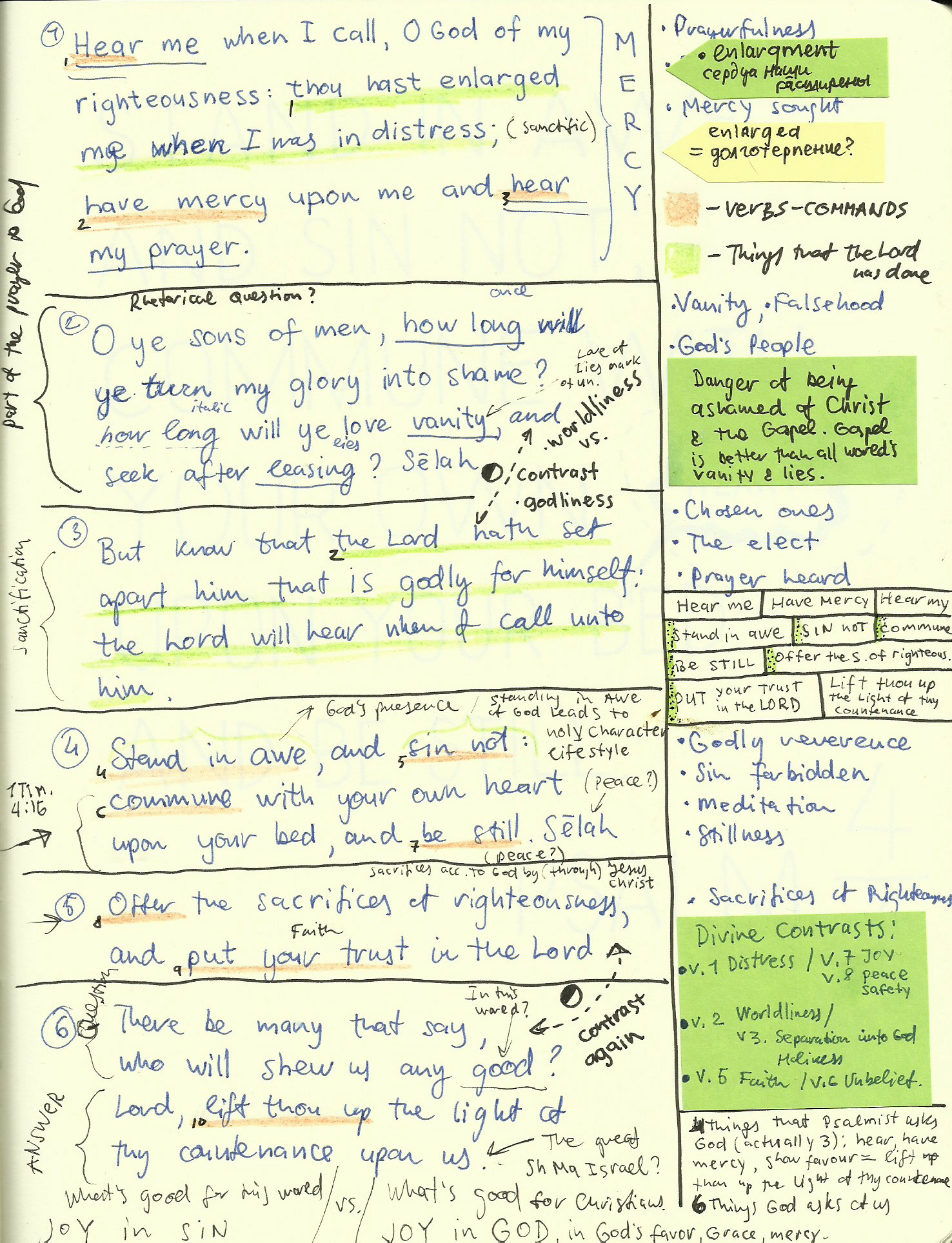
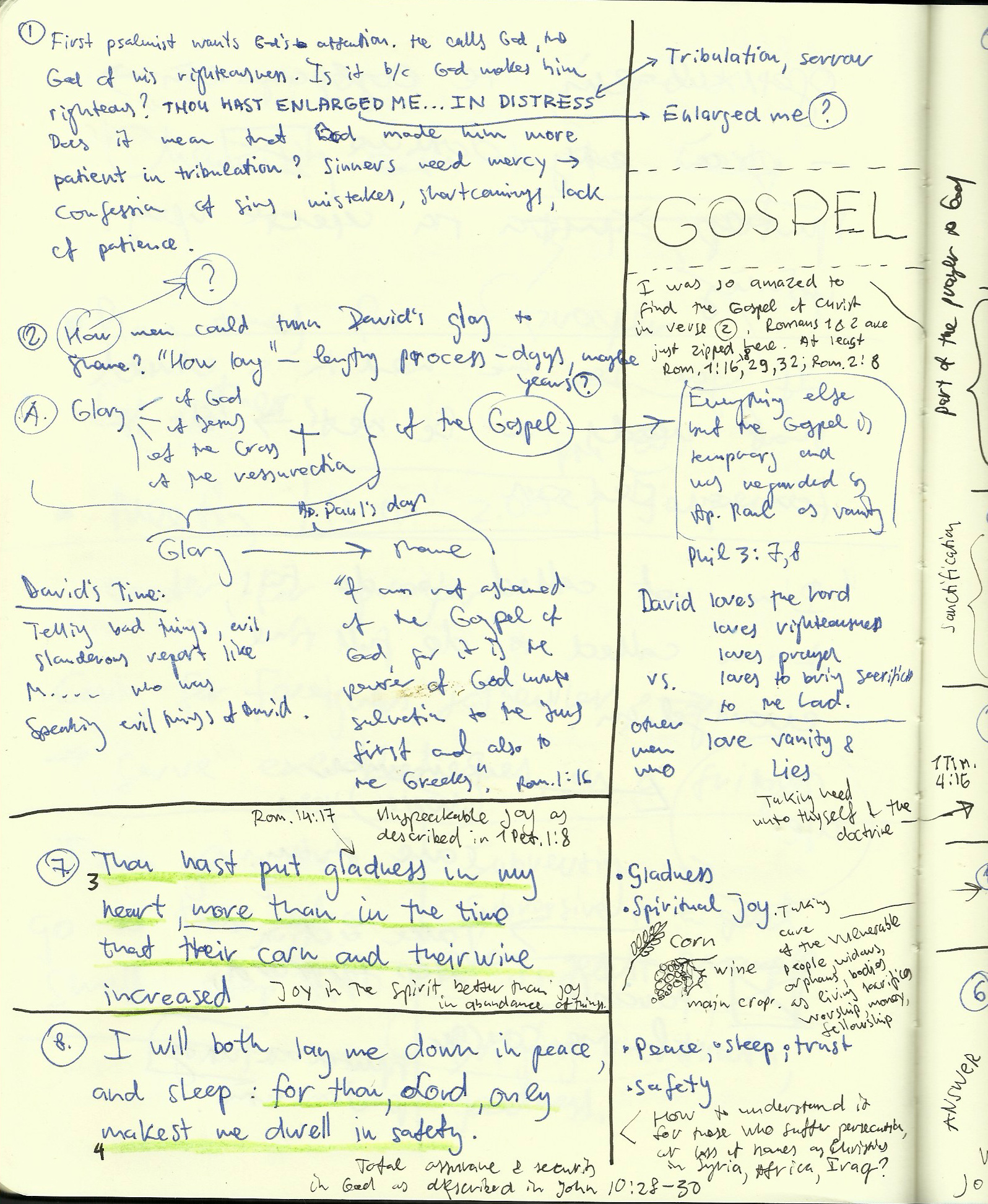
This is my exegesis or commentary on Psalm 4. Without going to Hebrew or Greek I just tried to find some contrasts, commands and verbs on which the whole structure of the Psalm hangs. As I started to read it slowly and think on each verse separately and then connecting them together many different things became more clear to me.
Verse 1. The fact that David’s heart was enlarged when he was in distress pointed me to Gal.5:22 where Apostle Paul speaks of longsuffering as the fruit of the Spirit. Greek word for it is makrothumia. It consists of 2 words makros and thumos.
Makros (DEF. – G3117; mak-ros’) adj. Long (in place [distant] or time [neuter plural]): far, long.
Thymos (DEF. – G2372; thoo-mos’) n. masc. Passion (as if breathing hard): fierceness, indignation, wrath; passion, angry, heat, anger forthwith boiling up and soon subsiding again.
Here I thought that Macros means big, but I was mistaken. Anyway, there still is some connection between the amount of distress we experience in our lives and our bearing fruit of patience as Christians, as it is written in Rom.5:3,4 but it cannot be directly stated from Ps.4:1 I honestly don’t know what it means that the Lord enlarged David when he was in distress.
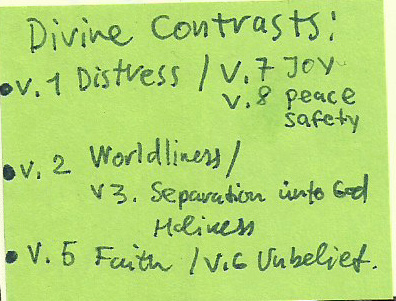
What I found for sure however is the striking contrast between v.1(Ps.4:1) and last verses of the Psalm (Ps.4:7,8) It’s the huge abyss between the distress and hopeless situation to the place of joy, gladness in the heart, peace and safety with deep assurance of God’s protection.
Verse 2. Maybe here I went to eisegesis, but this is what I found. I found the Gospel in verse 2. I understand that it was said in the context of men who turned the glory of David into shame but I just thought that it is a beautiful illustration of what the Lord could tell to us about being ashamed of the Gospel. I just thought that if God would ask me about my preaching the Gospel to others in this key:
Alex…how long will ye turn my glory into shame? how long will ye love vanity, and seek after leasing? Selah.
That would be convicting. That would speak right to my heart which on so many occasions is ashamed to speak of the Lord Jesus and His Glorious Gospel. That also would show me the reason of my fear to tell the truth – namely love of vanity of this present world and leasing (or lies of this world).
Ok. That maybe going too much into allegorizing the text. Those are my first steps in honest Scripture exegesis.
Verse 3. Here we see what the true holiness is all about. It is when God separates us for himself. The second part of the verse gives us assurance that if God heard David’s prayers, He will hear our prayers as well, for a saint in New Testament is referring not to Angels, or superspiritual sinless Christians, but to all disciples of Christ who believe in the name of Jesus and have been justified by grace alone through faith alone.
Verse 4. This verse really gives me some key on how not to sin. It is to be in awe of God, before God. It is impossible to sin when you are trembling in the presence of the Lord and here also psalmist advises us to talk to our hearts and be still. Couldn’t help to see the reference to 1 Timothy, where Apostle Paul admonishes young church leader to do 2 things:
Take heed unto thyself, and unto the doctrine; continue in them: for in doing this thou shalt both save thyself, and them that hear thee. (KJV)
Keep a close watch on yourself and on the teaching. Persist in this, for by so doing you will save both yourself and your hearers. (ESV) (1Tim.4:16)
I sort of connected talking to yourself on your bed with watching on yourself. Finally, we do have to calm down and commune with our hearts and still ourselves in God’s awesome presence. That’s really what I think it recommends us to do.
Verse 5. And then in verse 5 David encourages believers to both bring the sacrifices of righteousness and put our trust in the Lord. Of course David’s times sacrifices would differ from our NT sacrifices, but in both cases there would be uplifting of faith, looking unto the perfect sacrifice of Christ, looking unto the perfect righteousness of Jesus.
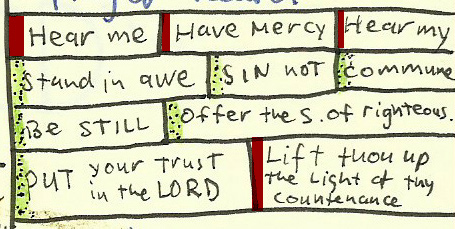
Now from this moment on I will just list main contrasts, verbs and commands of this Psalm.
Contrasts:
List of 10 Verbs, Commands and Requests:
I didn’t read
Mathew Henry or C.H. Spurgeon’s
“Treasury of David” commentaries before putting this together. I thought that would spoil all of the work. I would rather look up those tomorrow and fix all the mistakes.
*** *** ***
July 7, 2014 Update.
1. Mathew Henry’s comments on Ps.4:1
“Thou has formerly enlarged me when I was in distress, enlarged my heart in holy joy and comfort under my distresses, enlarged my condition by bringing me out of my distresses; therefore now, Lord, have mercy upon me, and hear me.’ The experience we have had of God’s goodness to us in enlarging us when we have been in distress is not only a great encouragement to our faith and hope for the future, but a good plea with God in prayer. “Thou hast; wilt thou not? For thou art God, and changest not; thy work is perfect.’
To be honest, I haven’t seen that in the text and I cannot see how he connects the Ps.4:1 with Ps.4:7,8 in explaining the enlargement of the heart. It doesn’t flow from the text. It is the beginning of prayer and not the end yet.
2. C.H. Spurgeon’s comments on Ps.4:1
“Thou hast enlarged me when I was in distress.” A figure taken from an army enclosed in a defile, and hardly pressed by the surrounding enemy. God hath dashed down the rocks and given me room; he hath broken the barriers and set me in a large place. Or, we may understand it thus:— “God hath enlarged my heart with joy and comfort, when I was like a man imprisoned by grief and sorrow.” God is a never-failing comforter.]
I don’t see here neither army figure of speech nor enlarging the heart with joy and comfort. It’s rather a nice overlapping or superimposition of joyful Ps.4:7,8 over sad Ps.4:1. It sounds uplifting and encouraging, but I would want to see what does enlarging of the heart truly means.
3. Pulpit Commentary comments on Ps.4:1
Thou hast enlarged me; or, made room for me—”set me at ease” In the language of the Old Testament, “straits” and “narrowness” mean trouble and affliction; “room,” “space,” “enlargement,” mean prosperity. David has experienced God’s mercies in the past, and therefore looks for them in the future (comp. Psa_3:7).
This is more clear, but then you have to see that interpretation: narrowness=affliction, enlargement=prosperity.
4. Sermon Bible Commentary comments on Ps.4:1
David has been in distress, and now the clouds have been blown away, and the blue sky has returned, so he does what many seldom think of doing: he thanks God for deliverance and enlargement, and takes no credit to himself.
Similar like C.H. Spurgeon’s comment. And almost verbatim like in The People’s Bible by Joseph Parker.
5. Dr. Bob Utley makes it a little more clear commenting on Ps.4:1 like this:
NASB, NKJV “relieved me”
NRSV, LXX “gave me room”
NJB “set me at large”
JPSOA, REB “freed me”
The Hebrew word (BDB 931, KB 1210, Hiphil perfect) is an idiom for a wide space (cf. Psa_18:19), the opposite of “restriction” (i.e., oppression, tribulation, narrow straights, BDB 865, “distress”). Its metaphorical nature can be seen in Gen.26:22; Deu.33:20; Psa.25:17; Isa.54:2; Isa.57:8.
Though Isa.57:8 context is negative I probably am right now closer to C.H. Spurgeon’s view that enlarging the heart means:
“God hath enlarged my heart with joy and comfort, when I was like a man imprisoned by grief and sorrow.” (CHS)
6. The People’s Bible by Joseph Parker comments like this on Ps.4:1
David replies: Look at me in my enlargement and thankfulness. My turn has come. You must not look at a man’s distress alone, and build an argument upon his sorrow; you must take into view the whole compass of his life.
So here J.Parker sees enlargement as David’s victory over distress if I understood him right.
7. JFB (Jamieson, Fausset and Brown) also goes in the similar lines like CHS on Ps.4:1
thou hast enlarged — expresses relief afforded in opposition to “distress,” which is expressed by a word denoting straits or pressure. Past favor is a ground of hope for the future.
How do they get to this: “Past favor is a ground of hope for the future.”? is it just because thou hast enlarged is in the Past Tense?
8. Keil and Delitzsch go deep into Hebrew and this is their take for Ps.4:1
Jahve is אֱלֹהֵי צֶדֶק, the possessor of righteousness, the author of righteousness, and the vindicator of misjudged and persecuted righteousness. This God of righteousness David believingly calls his God (cf. Ps.24:5; Ps.59:11); for the righteousness he possesses, he possesses in Him, and the righteousness he looks for, he looks for in Him. That this is not in vain, his previous experience assures him: Thou hast made a breadth (space) for me when in a strait. In connection with this confirmatory relation of בַּצָּר הִרְהַבְתָּ לִּי it is more probable that we have before us an attributive clause (Hitz.), than that we have an independent one, and at any rate it is a retrospective clause. הרחבת is not precative (Böttch.), for the perf. of certainty with a precative colouring is confined to such exclamatory utterances as Job.21:16 (which see). He bases his prayer on two things, viz., on his fellowship with God, the righteous God, and on His justifying grace which he has already experienced. He has been many times in a strait already, and God has made a broad place for him. The idea of the expansion of the breathing (of the stream of air) and of space is attached to the ח, Arab. ḥ, of רחב, root רח (Deutsch. Morgenl. Zeitschr. xii. 657). What is meant is the expansion of the straitened heart, Ps.25:17. Is.60:5, and the widening of a straitened position, Ps.18:20; Ps.118:5. On the Dag. in לִּי vid., on Ps.84:4.
At least they give us cross references that we might check out how this enlargement of the heart really works. Is.60:5 and Ps.118:5 are especially helpful.
9. Lange cites 2 other people apart from K&D to explain Ps.4:1
Ewald and Hupf. regard it as a relative clause, on account of its position between two imperatives. [Perowne: “Thou (that) in straitness hast made room for me.” This seems to be the best rendering. It makes the strophe more harmonious. It then refers to the deliverance from that critical situation in which he was placed before he received intelligence from Jerusalem, and crossed the Jordan into a wider and safer region. Here he could breathe more freely and make preparations to meet his foes.—C. A. B.]
Whoever those Ewald and Hupf. and mysterious C. A. B. were they would be right if David really wrote this Psalm after his son Absalom started chasing him.
10. But most of all I found that Spurgeon’s predecessor John Gill went long way in expounding what enlargment of the heart in Ps.4:1 really means:
thou hast enlarged me when I was in distress; when he had like to have been killed by Saul casting a javelin at him; and when his house was watched by men that Saul set there, and he was let down through a window and escaped; and when he was shut in at Keilah, where Saul thought he had him safe; and at other times, to which he may here refer, as in Ps.18:19; and this may be applied to the Messiah, when in the garden, beset with sorrows, and an angel strengthened him; and when on the cross, surrounded by various enemies, whom he conquered; and when in death and the grave, from the pains and cords of which he was loosed, and set in a large place.
And this agrees also with the experience of the saints; who, when in distress through sin, Satan, and the law, have been set free, through the Gospel proclaiming liberty to the captives to such enemies; and the opening of the prison to them that have been bound by them: and when they have been so shut up and straitened in themselves, that they could not come forth in the discharge of duty, and in the exercise of grace; through the Spirit of the Lord, who is a spirit of liberty, they have been enlarged in the duty of prayer and of praise, and in the exercise of faith and love; and their hearts have been enlarged through the discoveries of the love of God towards them, so that they have run cheerfully in the ways of his commandments; who also gives them largeness of heart, an increase of the knowledge of Christ, and of the love of God, and tills them with joy and peace in believing, and draws out the desires of their souls to his name, and the remembrance of him;
Wow! That’s really putting so many things into one phrase. Gill saw here both David and Jesus and us as Christians. And he saw them 1) enlarged in the duty of prayer and of praise, 2) enlarged in the exercise of faith and love; 3) their hearts have been enlarged through the discoveries of the love of God towards them, 4) largeness of heart, an increase of the knowledge of Christ, and of the love of God and final words that can very well be connected with Ps.4:7,8 “…and tills them with joy and peace in believing, and draws out the desires of their souls to his name, and the remembrance of him;”
That’s really a very good rendering of the Psalm. I wonder how other commentators overlooked that.
11. The Biblical Illustrator explains Ps.4:1 in this way:
2. A remembrance of God’s goodness. “Thou hast enlarged me when I was in distress.” The reference is to some deliverance which he had experienced. He remembered, perhaps, the goodness of God to him when, ill the field guarding his father’s flocks, he was delivered out of the paw of the lion and out of the paw of the bear; or His goodness to him in delivering him from the giant of Philistia. The memory of God’s past mercies to him gave courage to his heart and an argument in his prayer now. Because God has helped us we expect Him to help us again, and thus we plead. Not so with man. The more our fellow being has helped us the less reason we have to expect His aid. Man’s capacity for help is limited. The capability of God is unbounded.
You know, I start to believe that it really is a reference to some previous mercies, some previous times when God put David on a large place, or delivered him. All in all Biblical Ilustrator says that there are 3 things that help David to pray: 1) A recognition of God’s righteousness. 2) A remembrance of God’s goodness. 3) An invocation of God’s favour. “. . .Have mercy upon me and hear my prayer.”
12. Clarke says on Ps.4:1 that it is like if David was in prison:
Thou hast enlarged me – I was in prison; and thou hast brought me forth abroad. Have mercy on me – continue to act in the same way. I shall always need thy help; I shall never deserve to have it; let me have it in the way of mere mercy, as thou hast hitherto done. (Dallas Commentary is very similar to this thought)