


Wow. This picture makes me cry.
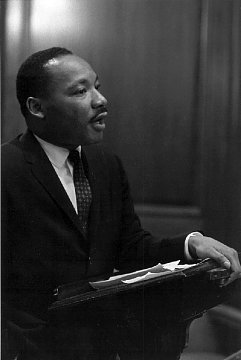
Just not to forget that I have to write a paper for Conflict Studies on Martin Luther King.

This story is about an exceptional man. His love for life and freedom were contagious. His fight against discrimination was diligent. His faith and courage were unmovable. This story is about Martin Luther King – a man ablaze for the freedom of people. Martin Luther King lived 39 years. But his impact upon the lives of people is gargantuan. Over the active period of eleven years (1957-1968) Martin Luther spoke around twenty five hundred speeches, wrote five books and wrote many articles. He ignited many people with passion for non-violent resistance for the human rights. Especially he struggled for the rights of the oppressed Black community in the United States. Wherever there was injustice – he wasn’t indifferent and tried to appear there to make a difference. However it wasn’t just his zeal that got assigned the Nobel Peace Prize in 1964. There was something more than a mere Black man’s charisma of that fascinated the Nobel Committee. It was the freshness of the ideas which he shared with the crowds and by their own words his being the first “…in the Western world to have shown us that a struggle can be waged without violence. to make the message of brotherly love a reality in the course of his struggle.”
His common method was to say a speech and to move people to a boycott, a march or other type of non-violent resistance to any kind of oppression. In one of his speeches King said:
“…The nonviolent resisters can summarize their message in the following simple terms: we will take direct action against injustice despite the failure of governmental and other official agencies to act first. We will not obey unjust laws or submit to unjust practices. We will do this peacefully, openly, cheerfully because our aim is to persuade. We adopt the means of nonviolence because our end is a community at peace with itself. We will try to persuade with our words, but if our words fail, we will try to persuade with our acts. We will always be willing to talk and seek fair compromise, but we are ready to suffer when necessary and even risk our lives to become witnesses to truth as we see it.”
So this is the quintessence of his movement. Most of what he said was heavily influenced by the success of Gandhi in the East, where Gandhi was able to resist the oppression of the British government by leading the protesters at Dandi Salt March in 1930. Similarly as Gandhi King was able to apply principles of non-violence on a great Western scale.
The historical background of King’s Days was very grim. The segregation between Black and White populations was very strong in 1950’s